
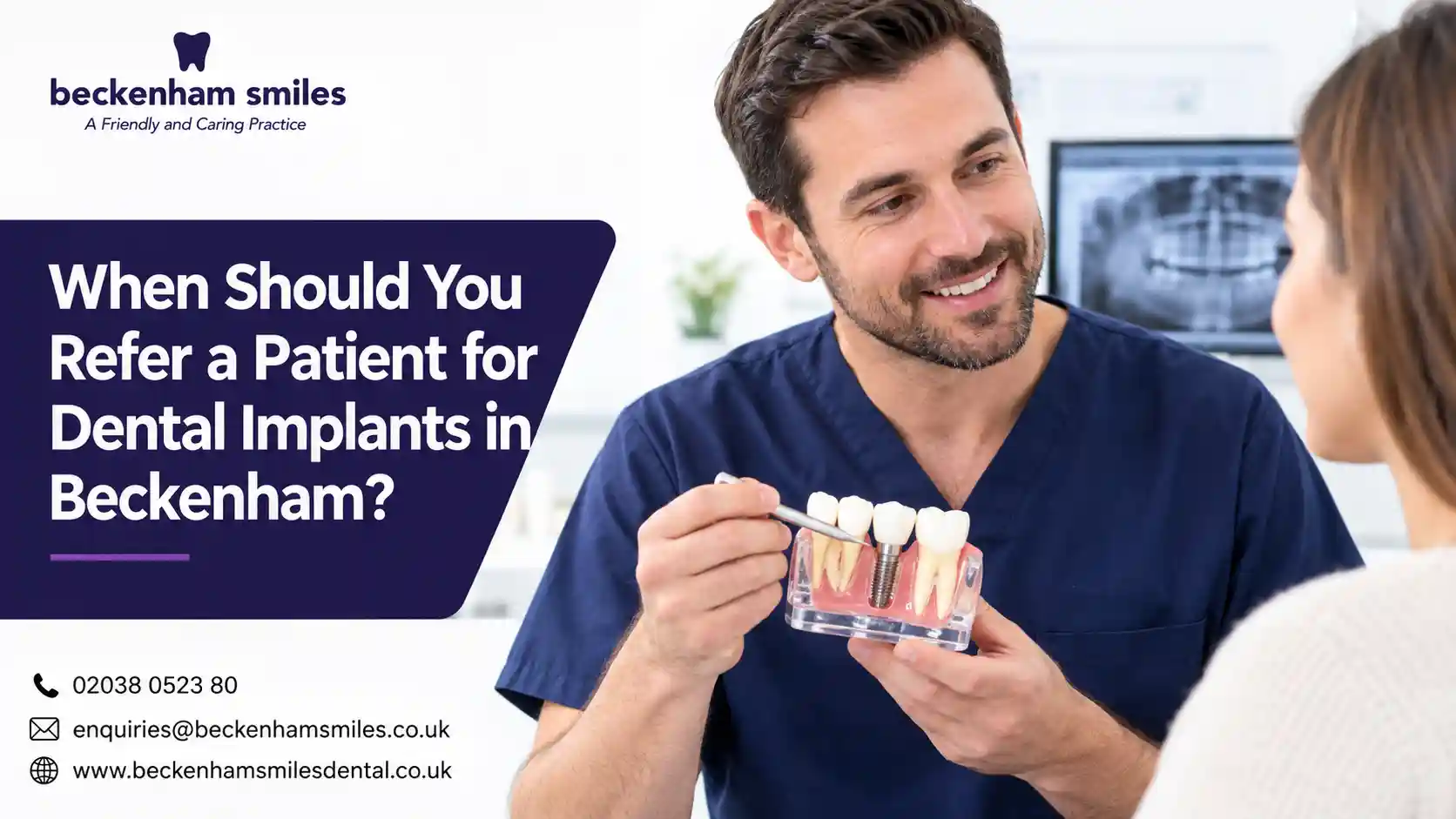
Deciding when to refer a patient for a dental implant is one of the more nuanced judgement calls a general dental practitioner makes. Some cases are straightforward: a single missing tooth, healthy bone, no complicating medical history. Others are far less clear, involving bone loss, periodontal disease, or a patient who has already had a difficult extraction history. This guide sets out the clinical signs worth watching for, the situations where a dental implant referral in Beckenham is likely to serve your patient well, and what the referral pathway looks like once you make that decision.
At Beckenham Smiles Dental, we work with local GDPs across Beckenham and the surrounding areas to provide a straightforward, well-supported referral service for single and multiple implants, All-on-4 treatment, and associated procedures such as bone grafting. This article is written for referring dentists who want a clearer framework for deciding when a patient should be assessed by an implant dentist in Beckenham, rather than managed with conventional restorative options alone. Once a referral is agreed, patients can book an appointment with us directly for their initial consultation.
What Counts as a Dental Implant Referral?
A dental implant referral is the process by which a general dentist sends a patient to a colleague with additional training and experience in implant placement, typically because the case involves surgical planning, bone assessment, or restorative complexity beyond the referring practice’s usual scope. It does not mean handing over the patient permanently. Most referral arrangements are collaborative, with the referring dentist continuing routine care and the implant dentist managing the surgical and prosthetic stages.
For many practices, particularly smaller ones without in-house CBCT imaging or surgical facilities, referral is simply the most practical way to give a patient access to a full range of treatment options without the practice needing to invest in specialist equipment or training.
When Should You Refer a Patient for Dental Implants?
A patient should generally be referred for a dental implant assessment when there is a missing tooth or teeth with adequate healing time, when conventional restorative options such as bridges or dentures are unsuitable or unwanted, or when the case involves bone loss, sinus proximity, or medical factors that need specialist evaluation before treatment can proceed safely.
Beyond that general answer, several specific clinical situations tend to prompt a referral conversation.
1. Single Tooth Loss With Good Bone Volume
This is often the most straightforward referral. A patient with a single missing tooth, healthy surrounding bone and gum tissue, and no significant medical contraindications is usually a good implant candidate. Referring early, rather than waiting years after extraction, helps preserve bone volume and gives the implant dentist more options.
2. Multiple Missing Teeth or Failing Bridgework
Patients with several missing teeth, or an existing bridge that is failing due to decay under the abutment teeth or recurrent mobility, often benefit from an implant-supported alternative. This is also a common point at which patients start asking about implants themselves, having read about them or seen a friend’s results, so a referral gives them an informed comparison rather than a default repeat of the same bridge design.
3. Denture Intolerance or Instability
Patients who struggle with loose dentures, gagging, reduced chewing confidence, or sore spots are frequently good candidates for implant-retained overdentures. This is one of the most common reasons GDPs in Penge, Anerley and the wider Beckenham area refer patients to us, since denture-related complaints tend to build up gradually rather than appearing as an emergency. Patients keen to move things forward quickly are welcome to book an appointment once you have made the referral.
4. Extensive Tooth Loss Requiring All-on-4 or Full-Arch Solutions
Where a patient is facing full clearance, or already has a failing full denture, a referral for assessment of full-arch options such as All-on-4 implants is worth raising early. These cases usually require CBCT imaging and detailed treatment planning, so earlier referral gives more time to plan properly rather than rushing a decision.
5. Cases Involving Bone Loss or Sinus Proximity
If a patient has had a tooth missing for some time, periodontal disease, or the upper posterior region is involved, bone volume can be a limiting factor. These cases often need a bone graft or sinus lift before or alongside implant placement. This is precisely the kind of assessment that benefits from specialist imaging and experience, and is a clear signal for referral rather than in-house management.
6. Medical or Risk Factors That Need Specialist Judgement
Diabetes, smoking, bisphosphonate use, or a history of periodontal disease do not automatically rule out implant treatment, but they do change the risk profile and the assessment needed beforehand. When these factors are present, referring for a dedicated implant consultation ensures the patient receives an honest, individually assessed opinion rather than a generic yes or no.
Referral Suitability at a Glance
| Clinical Situation | Typical Referral Priority | Likely Additional Assessment |
| Single tooth loss, good bone | Routine referral | Intra-oral X-ray, occasionally CBCT |
| Multiple missing teeth or failing bridge | Routine to moderate priority | OPG or CBCT scan, restorative planning |
| Denture instability or intolerance | Moderate priority | Bone assessment, denture history review |
| Extensive tooth loss, full-arch need | Early referral recommended | CBCT scan, All-on-4 suitability review |
| Bone loss or sinus proximity | Refer before treatment planning | CBCT scan, possible bone graft or sinus lift |
| Medical risk factors present | Refer for specialist opinion | Full medical history review, risk assessment |
This table is a general guide rather than a diagnostic tool. Every patient still needs an individual clinical assessment before any treatment plan is confirmed.
When Referral May Not Be Necessary Yet
Not every gap needs an immediate implant referral. If a tooth has only recently been extracted and the socket is still healing, it is often sensible to allow adequate healing time first, typically several months, before assessment. Similarly, patients who are not medically fit for surgery at the time, who are pregnant, or who have uncontrolled periodontal disease that needs stabilising first, are usually better served by addressing those issues before an implant referral is made. This does not close the door on implants for later, it simply means the timing needs to be right.
What Happens After You Refer a Patient
- Referral received. We review the referral letter, any radiographs provided, and relevant medical history.
- Consultation booked. The patient attends an initial assessment, which may include further imaging such as an OPG or CBCT scan.
- Treatment plan discussed. Options are explained clearly, including realistic expectations, risks, and approximate costs, without promising a guaranteed outcome.
- Feedback to referring dentist. We keep referring practices informed of the proposed plan and progress, so ongoing routine care can continue smoothly alongside implant treatment.
- Treatment and restoration. Surgical placement is followed by a healing period, then restoration with the crown, bridge, or denture component.
Patients are welcome to ask questions about the whole process before committing, and nothing is treated as guaranteed until a full clinical assessment has taken place.
Cost Considerations Worth Mentioning to Patients
Patients often ask about cost before agreeing to a referral, so it helps to give a general indication rather than leaving them to search online. At Beckenham Smiles Dental, a single dental implant starts from £2,500, with bone grafting or a sinus lift from £500 where needed, and All-on-4 full-arch treatment from £12,500. These are starting figures, and the final cost depends on the individual treatment plan following assessment. Interest-free finance is available through Tabeo, which some patients find makes treatment more manageable when spread over several months.
Common Mistakes Practices Make When Referring
- Waiting too long after extraction. Bone resorption begins soon after a tooth is lost, so early referral preserves more options.
- Assuming a patient isn’t interested without asking. Many patients simply haven’t been offered the option, rather than having actively declined it.
- Sending incomplete referral information. Including relevant radiographs, medical history, and a brief clinical note speeds up the assessment process considerably.
- Overpromising outcomes to the patient before referral. It’s better to explain that a specialist opinion will confirm suitability, rather than setting expectations that may not match the eventual assessment.
Who This Applies To
This guidance is aimed at general dental practitioners in Beckenham and neighbouring areas including Elmers End, Eden Park, West Wickham, Sydenham, Crystal Palace, Shortlands and New Beckenham who are weighing up whether a particular patient would benefit from specialist implant assessment. It is not intended as a substitute for individual clinical judgement, and every patient referred still undergoes a full, independent assessment before any treatment is agreed.
A Local Referral Pathway
Beckenham Smiles Dental is based at 122-124 High Street, Beckenham, BR3 1EB, making it a convenient referral point for practices across the local area. We offer single and multiple implant placement, implant-supported crowns, bone grafting, and All-on-4 treatment, supported by modern imaging and a structured referral process designed to keep referring dentists informed at each stage. If you would like to discuss a referral or send over a patient’s details, you can get in touch with our team directly or use our dedicated referral page for dentists.
For patients themselves, we always recommend booking a full consultation before any decisions are made, since imaging and an in-person assessment are the only reliable way to confirm suitability.
If you have a patient you think may be suitable for implant treatment, you can find more detail and our referral form on our Dental Implant Referrals for Dentists page, or view our general Dental Implants Beckenham page for information you may want to share with patients ahead of their appointment. To refer a patient or ask a question first, please get in touch with our team, or your patient can book an appointment directly once the referral has been agreed.
Frequently Asked Questions
You can refer a patient by contacting Beckenham Smiles Dental directly with the patient’s details, relevant radiographs, and a brief clinical note. We will then book an initial consultation and keep you updated on the proposed treatment plan.
Not always. A recent intra-oral X-ray or OPG is often sufficient initially. If further imaging such as a CBCT scan is needed, this can be arranged as part of the implant assessment.
There is no single fixed timeframe, but earlier referral, once the socket has healed adequately, generally preserves more bone and gives more treatment options than waiting several years.
In many cases, yes, often with a bone graft or sinus lift performed either before or alongside implant placement. Suitability depends on the extent of bone loss and is confirmed through assessment and imaging.
Smoking increases certain risks around healing and long-term implant success, but it does not automatically exclude a patient from treatment. It is one of several factors considered during a specialist assessment.
A single implant replaces one missing tooth, while All-on-4 uses four implants to support a full arch of replacement teeth, typically for patients facing extensive tooth loss or full clearance.
Yes. We aim to keep referring practices informed of the proposed treatment plan and progress, so routine care can continue smoothly alongside implant treatment.
At Beckenham Smiles Dental, a single implant starts from £2,500, with additional costs depending on factors such as bone grafting or the type of restoration required. A full quote is provided after assessment.
Yes, interest-free finance is available through Tabeo, which allows the cost to be spread over a period agreed with the patient.
If assessment shows implants aren’t the right option, alternative solutions such as bridges or dentures are discussed, and the referring dentist is kept informed of the outcome.
Yes. We regularly accept referrals from practices across Penge, Anerley, West Wickham, Sydenham, Crystal Palace and surrounding areas, in addition to Beckenham itself.
Yes, patients are also welcome to book a consultation directly if they would like to discuss dental implants themselves, without needing a referral from another practice.