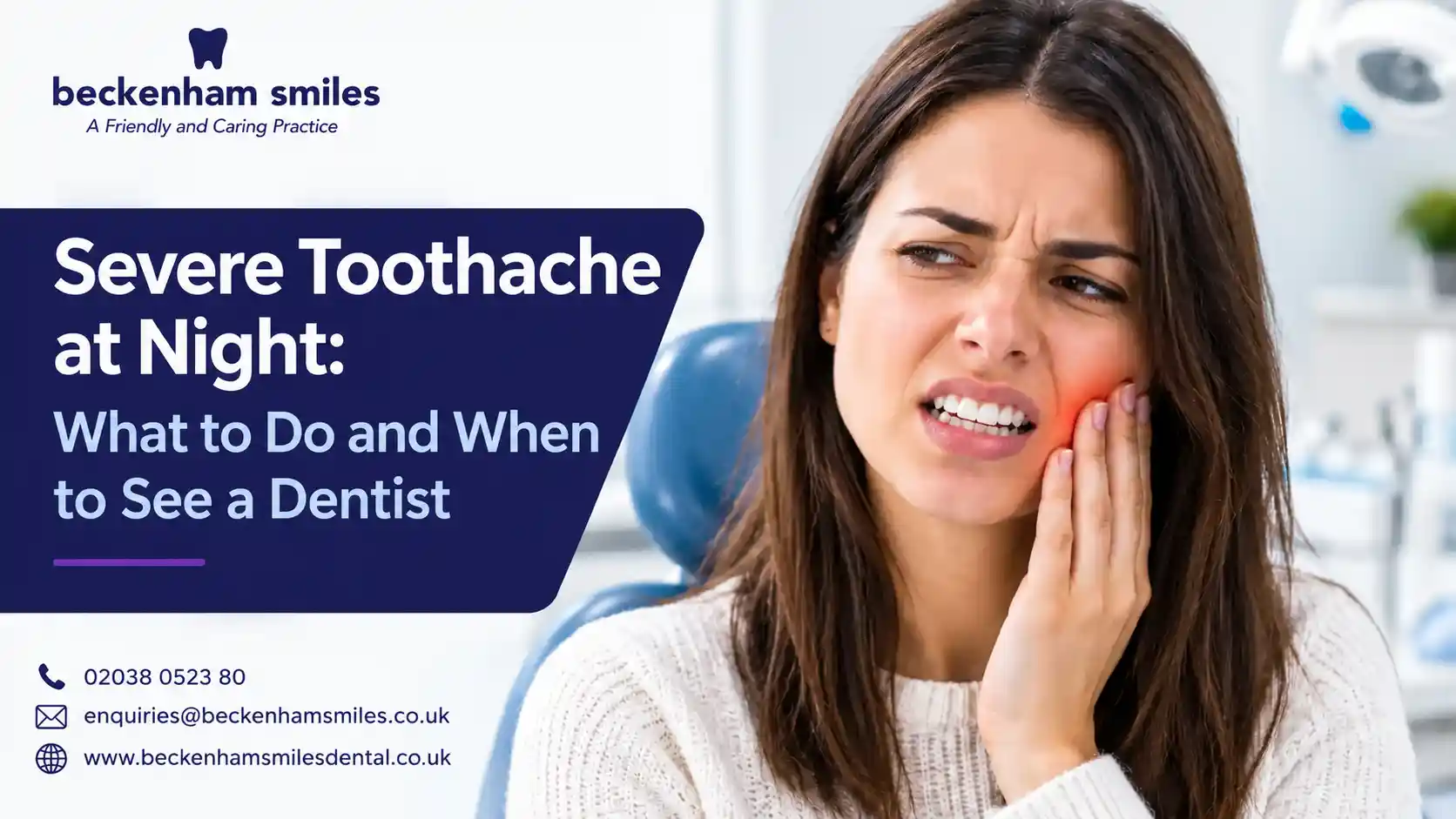
Severe toothache at night can feel relentless. The house is quiet, nothing distracts you, and a tooth that was only mildly sore during the day can start to throb as soon as you lie down. If that sounds familiar, you are not alone, and there are sensible steps you can take tonight while you arrange proper care.
This guide explains what to do, why tooth pain often feels worse after dark, which symptoms need prompt attention and how a dentist at Beckenham Smiles Dental may approach the problem. Patients in Beckenham, Penge and Anerley can contact us during opening hours to talk through their symptoms.
If you have difficulty breathing or swallowing, or swelling that is spreading quickly across your face or neck, call 999 or go to A&E straight away. Do not wait for a dental appointment.
Severe toothache? Get dental advice
Contact Beckenham Smiles Dental to discuss your symptoms and ask about appointment availability.
Call Beckenham Smiles Dental on 0203 805 2380
Book your appointment online
Monday to Friday, 8am to 6pm. Appointments subject to availability.
What Is the Quickest Safe Way to Cope With Severe Toothache at Night?
Rinse gently with warm water, avoid very hot, cold or sugary foods and drinks, and do not chew on the sore side. Ask a pharmacist which over-the-counter pain relief suits you. These steps only ease discomfort. Pain that is severe, getting worse or lasting more than two days needs a dental examination.
What Should You Do If You Have Severe Toothache at Night?
Start with the basics. Nothing here treats the cause of the pain, but it can make the night more bearable.
Check for symptoms that need emergency medical help
Difficulty breathing or swallowing, or swelling that is spreading quickly across the face, mouth or neck, is a medical emergency. Call 999 or go to A&E. The same applies if you feel severely unwell alongside facial swelling.
Keep the area clean
Rinse your mouth with warm water and brush carefully, avoiding the most tender spot if it hurts too much. If food is trapped between your teeth, try gentle flossing or an interdental brush. Never force anything into the gum or tooth, and do not poke at it with a pin or any sharp object.
Avoid irritating the painful tooth
Choose soft foods and try not to chew on the affected side. If hot drinks, cold water or sweet foods set off a sharp pain, leave them alone until the tooth has been checked.
Get advice about pain relief
A pharmacist can recommend suitable over-the-counter pain relief. Follow the instructions on the packet, and mention any medical conditions, allergies or other medicines you take, because not every painkiller suits everyone. Pain relief can take the edge off, but it will not fix whatever is causing the problem.
Why Does Toothache Get Worse at Night?
Many people notice tooth pain more in the evening. When you lie down, you may feel more pressure in your head and face, and with fewer distractions around, an existing ache is harder to ignore. This does not mean night-time toothache is always serious, and it certainly does not always mean infection. Several different problems can cause it, and the pain alone cannot tell you which one you have.
Tooth decay
Decay gradually breaks down the outer layers of a tooth. In its early stages it may cause occasional sensitivity. As it gets deeper, the pain can become more frequent and harder to ignore.
Inflammation inside the tooth
The pulp is the soft tissue at the centre of a tooth, containing nerves and blood vessels. When it becomes irritated or inflamed, pain can be persistent or throbbing, and it may start without any obvious trigger.
A cracked tooth or damaged filling
A crack, or a filling that has worn down or broken, can cause sharp pain when you bite and sensitivity to hot or cold. The discomfort can come and go, which makes it tricky to pinpoint without an examination.
Infection around the tooth
Pain with swelling, a bad taste in the mouth or a fever can point to infection, including a dental abscess. This needs prompt assessment by a dentist.
Other possibilities
Gum problems, a recent extraction or recent dental work can also cause pain. If you had a tooth removed a few days ago and the pain is getting worse rather than better, contact the practice that treated you.
When Should You See a Dentist, and When Is It an Emergency?
Contact a dentist promptly if you have any of the following:
- Severe or persistent tooth pain
- Pain that does not ease with appropriate pain relief
- Swelling of the gum or cheek
- Pain with a fever, a bad taste or pain when biting
- Pain after an injury or after recent dental treatment
- Toothache that has lasted more than two days (NHS guidance recommends seeing a dentist at this point)
The table below sets out who to contact and when.
| Situation | What to do | Examples |
| Needs prompt dental care | Contact a dentist as soon as the practice is open | Severe or persistent pain, swelling of the gum or cheek, pain when biting, pain lasting more than two days |
| Practice is closed or you are unsure | Use NHS 111 online for urgent advice | Intense pain at night or at the weekend, not sure how urgent it is, cannot reach a dentist |
| Medical emergency | Call 999 or go to A&E | Difficulty breathing or swallowing, rapidly spreading swelling of the face or neck, uncontrolled bleeding, serious injury to the head or face |
If you suspect an abscess, do not wait for it to settle. Pain can ease when an abscess drains, but that does not mean the infection has gone. Our guide to [emergency dental care in Beckenham]([PILLAR PAGE URL]) explains how urgent appointments work.
Pain getting worse? Do not rely on temporary relief alone
Call us to describe your symptoms and ask about availability.
Call Beckenham Smiles Dental on 0203 805 2380
Book your appointment online
Monday to Friday, 8am to 6pm. Appointments subject to availability.
What Will a Dentist Do About Severe Toothache?
At an emergency appointment, the dentist will ask when the pain started and what makes it better or worse. They will examine the tooth and the surrounding gum, and may take an X-ray where it is appropriate. Only then can they explain what is likely to be causing the problem and what your options are. Treatment depends entirely on those findings, and no outcome can be promised before you have been examined.
Treating tooth decay
If decay is the cause, the dentist may recommend removing it and restoring the tooth. A white filling is one option for suitable cavities.
Root canal treatment
Root canal treatment may be considered when the pulp is badly inflamed or infected and the tooth can be kept. The dentist will explain whether it is likely to be suitable in your case.
Treating a dental abscess
The dentist will look for the source of the infection and decide how to treat it. That may involve draining the abscess, treating the tooth or, in some cases, removing it. Antibiotics are not a substitute for treating the underlying problem, and the dentist decides whether they are needed.
Repairing a cracked or damaged tooth
The right option depends on where the damage is and how deep it goes. Some teeth can be repaired with a filling, while others may need a crown. If a tooth cannot be restored predictably, the dentist may discuss an extraction.
How Much Does Emergency Dental Treatment Cost in Beckenham?
Costs depend on what the dentist finds, so the figures below are starting prices rather than a total. Our emergency appointment starts from £85. Any treatment is charged separately and may cost more than the examples shown.
- Intra oral X-ray: £19 to £22
- White filling (1 to 3 surfaces): from £185 to £295
- Abscess treatment: from £125
- Dry socket treatment: from £195
- Root canal treatment: from £495
- Extraction: from £200
You can see the full list in our dental treatment fees. For larger treatments, 0% APR finance is available through Tabeo, subject to approval. The practice team can explain the details.
Want to know your options and costs?
Contact us for an assessment and a clear explanation of the next steps.
Call Beckenham Smiles Dental on 0203 805 2380
Book your appointment online
Monday to Friday, 8am to 6pm. Appointments subject to availability.
Can You Wait Until Morning for Toothache?
It depends on your symptoms, so a simple yes or no would not be honest. If the pain is mild and settles with sensible home care, you may be able to contact a dentist when the practice opens. If it is severe, keeps getting worse or comes with swelling or a fever, do not simply sit it out.
When the practice is closed, you can use NHS 111 online for urgent advice. For breathing or swallowing difficulty or rapidly spreading swelling, call 999 or go to A&E instead.
Beckenham Smiles Dental is open Monday to Friday, 8am to 6pm, and closed on Saturdays, Sundays and bank holidays. If pain starts on a Friday evening, contacting us when we open on Monday may be too long to wait, so use NHS 111 online if you need advice sooner.
Common Mistakes to Avoid
- Putting aspirin on the tooth or gum. It does not work this way and can burn the soft tissue.
- Using leftover antibiotics. They may be the wrong type, the wrong dose or unnecessary, and they will not treat the cause of the pain.
- Applying household chemicals or strong substances. These can damage the gum and the inside of the mouth.
- Squeezing or puncturing a swelling. This can spread infection and make things worse.
- Waiting for the pain to disappear. Pain can ease for a while even though the underlying problem is still there.
- Taking more pain relief than the label allows. Always follow the packet instructions or ask a pharmacist.
Can You Prevent Toothache?
Not every toothache can be prevented, but good habits lower the risk of the problems that commonly cause it. Brush twice a day with fluoride toothpaste, clean between your teeth, and cut down on sugary snacks and drinks. Regular check-ups at a general dentistry appointment allow small problems to be found and treated before they turn into night-time pain.
How to Arrange an Emergency Dental Appointment in Beckenham
If you are looking for an emergency dentist in Beckenham, this is how to get started:
- Contact us during opening hours. Call the practice or use the online booking portal.
- Describe your symptoms. Say when the pain began, whether you have swelling or a fever, and whether biting makes it worse.
- Ask about availability and costs. This helps you know what to expect before you arrive.
- Confirm before you travel. Appointments depend on availability, so check with the team first.
Beckenham Smiles Dental
122-124 High Street, Beckenham, BR3 1EB
Phone: 0203 805 2380
Email: enquiries@beckenhamsmiles.co.uk
Monday to Friday, 8am to 6pm. Closed Saturday, Sunday and bank holidays.
You can also use our contact page to get in touch.
Conclusion
Toothache at night is hard to live with, but you do not have to cope with it alone. Gentle home care can get you through the evening, yet it cannot tell you what is wrong. A dentist can examine the tooth, find the likely cause and explain your options clearly. If your pain is severe, getting worse or has lasted more than two days, arrange an assessment. If you have trouble breathing or swallowing, or fast-spreading swelling, get emergency medical help straight away.
Get help with severe toothache
Call Beckenham Smiles Dental on 0203 805 2380
Book your appointment online
122-124 High Street, Beckenham, BR3 1EB
Monday to Friday, 8am to 6pm. Appointments subject to availability.
Frequently Asked Questions About Toothache at Night
Lying down and having fewer distractions can make existing pain more noticeable. The cause could be decay, inflammation inside the tooth, a crack or an infection. Only a dental examination can confirm which.
You can rinse gently with warm water, eat soft foods, avoid trigger foods and ask a pharmacist about suitable pain relief. These steps may ease discomfort for a while, but they do not treat the cause
Pain sometimes eases for a time, but the underlying problem usually remains. Toothache that lasts more than two days, or keeps returning, should be checked by a dentist.
No. Decay, a cracked tooth, a damaged filling or inflammation inside the tooth can all cause severe pain. Pain with swelling, a bad taste or a fever should be assessed promptly in case infection is involved.
No. Aspirin placed on the tooth or gum can burn the soft tissue and does not relieve the pain. Ask a pharmacist for advice on suitable painkillers instead.
No. Antibiotics are not suitable for every toothache and need to be prescribed for you. Leftover tablets may be the wrong type or dose, and they do not replace dental treatment.
Seek emergency medical help for difficulty breathing or swallowing, rapidly spreading swelling of the face or neck, or uncontrolled bleeding. Contact a dentist promptly for severe, worsening or persistent pain, or pain with swelling or a fever.
Use NHS 111 online for urgent advice. Follow the safe home care steps in this guide, and contact the practice when it reopens. Call 999 or go to A&E for any serious symptoms.
Emergency appointments at Beckenham Smiles Dental start from £85. Treatment is charged separately and may cost more, depending on what the dentist finds. You can check our fee guide for current starting prices.
You can call the practice or use our online booking portal during opening hours to ask about urgent appointments. Availability must be confirmed and cannot be guaranteed.